
Tuesday, June 9, 2026Sports Chronicle
DailyClubGolf

Bryson DeChambeau Makes Significant Equipment Change at LIV Golf Singapore

HONGKONG LIV-GOLF American professional golfer, Bryson DeChambeau during a game in Fanling Golf Course where LIV Golf Hong Kong is being held in Hong Kong, March 5, 2026. NEXPHER/Vernon Yuen HONG KONG

Bryson DeChambeau has been struggling with his wedges for some time, but this week at Sentosa, he decided it was time to make a fresh start.

The Crushers GC captain arrived at LIV Golf Singapore on Thursday, March 12, with two new wedges in his bag. The move is part of a bigger effort to improve his short game, and the change is because one problem has quietly been costing him shots for a while.

Speaking at his press conference on Thursday, March 12, DeChambeau spoke openly about the problem. His previous wedges were not moving through soft turf cleanly enough. Because of that, the ball was not getting the right spin, and his distance control was also affected.

“That new bounce that I’m using is going to help me in softer conditions,” he said.

"Because that's really what I'm struggling with."
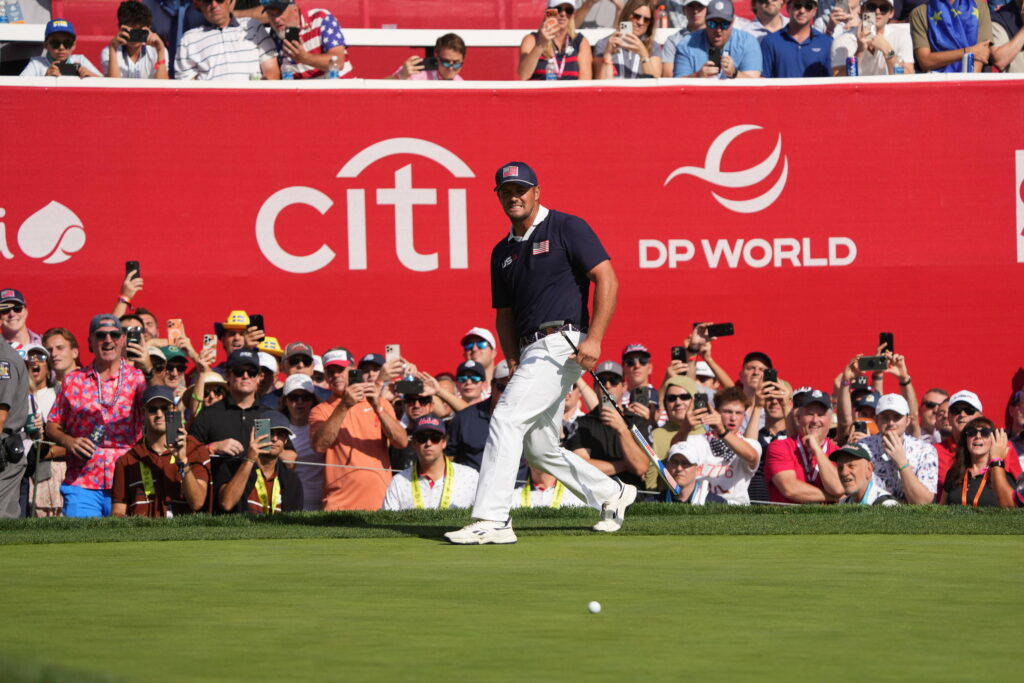
Ryder Cup 2025 Bryson Dechambeau from the edge of the green during SaturdayÕs Foursomes at the 2025 Ryder Cup, Bethpage Black Golf Course, Farmingdale, New York, USA. 27/09/2025 Picture: Golffile JJ Tanabe All photo usage must carry mandatory copyright credit Golffile JJ Tanabe Farmingdale Bethpage Black Golf Course New York USA Copyright: xJJxTanabex *EDI*,

The Bettinardi wedges move through the turf differently. During practice at Sentosa, the early results looked positive. “It’s going through the turf a lot better from the fairway,” DeChambeau said.

However, he did not get a proper chance to test them in his opening round. On the 11th hole, a jumper from the left rough meant the new wedges were not really used the way he wanted.

“I didn’t really get to test the wedges,” he said. But he is still trusting the process and believes the change will help over time.

The new clubs are Bettinardi HLX 5.0 Forged wedges, and they replace his PING S159 50° and PING Glide 4.0 56°.

But the problem is not only about the wedges. DeChambeau said his irons may also be part of the issue.

“I don’t think I have enough bounce on my irons,” he said.

“The club is moving through the turf differently, which changes the spin and also affects the distance.”

Sentosa Is Exposing Bags Across the Entire Field

DeChambeau is not the only player looking for solutions this week. In Singapore alone, there have been 51 club changes across the field.

So far this season, the total number of equipment changes on tour has reached 351.

Tyrrell Hatton had an unexpected problem during the pro-am when his PING G430 driver head broke. He had to switch to the newer G440 model.

Sergio Garcia also made two changes, moving to a Titleist GT3 driver with a True Temper Project Titan Black 70 TX shaft.

Danny Lee decided to stop using his broomstick putter. Thomas Detry changed to Callaway SP wedges in search of more spin.

Sentosa Golf Club has a reputation for exposing problems players might have been ignoring.

For DeChambeau, the new Bettinardi wedges are his solution, and the course at Sentosa will soon show whether that decision was the right one.

Do you think the equipment changes will help DeChambeau find his best change at Sentosa? Let us know in the comments!

Read more at Daily Club Golf!

Trending slideshow: From Old Tom to Bryson DeChambeau: The Game’s Greatest Influencers

Aditi Singh From Old Tom to Bryson DeChambeau: The Game’s Greatest Influencers
From Old Tom Morris crafting the sport’s earliest footsteps to Bryson DeChambeau turning golf into a laboratory experiment, the game’s greatest influencers have always pushed boundaries in their own strange and brilliant ways. This lineup brings together the icons who built golf, the stars who reshaped it, and today’s digital showmen who swing for both the fairway and the feed. Dive in to see who moved the game forward and how they did it. Adam Cairns-USA TODAY Sports
Born in 1821 in St Andrews, Old Tom Morris became one of golf’s first true icons. He learned the game as a boy on the links, worked under Allan Robertson in the 1840s, and later designed Prestwick’s 12-hole course. He helped shape early challenge matches and built a fierce rivalry with Willie Park. Morris also played a central role in the creation of The Open in 1860 and set standards that guided golf’s early growth. Sarah Fabian-Baddiel/Heritage Images/IMAGO
From 1923 to 1930, Bobby Jones won 13 majors and became the only player to complete the Grand Slam, a feat he achieved at age 28 before retiring from competition. His poise under pressure, his “sheer delicatessen” shotmaking, and his changes in temperament helped define golf’s Golden Age. Jones also influenced the sport through course design, co-founding Augusta National, and helping create the Masters. Mark Newcombe/Imago
Ben Hogan changed golf by rebuilding his swing. His weaker grip, cupped lead wrist, and open clubface created a fade-based pattern that produced a shallow, powerful downswing. Hogan proved that a hook can be controlled by learning to fade, saying, “Try to do the opposite of what you think, and then you have a great golf swing.” His detailed methods in Five Lessons and his precision-driven technique influenced every generation that followed. Mark Newcombe/Imago
“I’ve been lucky to live the best life any man could wish for,” Arnold Palmer once said, and golf felt the same about having him. His victories at Augusta, the rise of Arnie’s Army, and his connection with television turned the sport into a national spectacle. Palmer helped shape the Masters, influenced athlete marketing, and built a bond with fans that no player has matched. Stephen M. Dowell/Orlando Sentinel/MCT/Imago
GOAT status fits Jack Nicklaus not just because of his 18 majors but because of how completely he defined championship golf. His career stretched from 1962 to 1986, producing a record that includes 19 runner-up finishes and nine thirds, numbers no one has approached. His sportsmanship, longevity, and course-design legacy make his claim to greatness unmatched. Paul J Sutton/PCN Photography/Imago
Born in 1957 in Pedreña, Seve Ballesteros rose from hitting stones with a 3-iron to becoming the most creative shot maker of his era. He reshaped modern golf by proving that imagination could beat textbook technique, inspiring a generation of European players to compete with the Americans. His wins at the 1980 and 1983 Masters and his 1984 triumph at St Andrews accelerated golf’s growth across Europe. IMAGO / Dreamstime
Nancy Lopez changed women’s golf by proving that talent and personality could lift an entire tour. Her historic 1978 rookie season, with nine wins and a sweep of Rookie of the Year, Player of the Year, and the Vare Trophy, drew national attention to the LPGA at a time when the women’s game struggled for visibility. As the tour’s first prominent Latina star, she expanded representation and opened doors for future players like Lorena Ochoa and Lizette Salas. St. Petersburg Times/ZUMA Press Wire/Imago
After turning pro in 1992, Annika Sörenstam dominated the LPGA with 72 wins and 10 majors, highlighted by her historic 59, the lowest round ever recorded in the women’s game. Her 2003 appearance at the Colonial challenged long-standing barriers and made her a global symbol of progress. Beyond competition, she expanded the sport’s reach through the ANNIKA Foundation, which has supported hundreds of young players across more than 60 countries. Romeo Guzman/ Newscom World/Imago
Tiger Woods reshaped golf more completely than any athlete before him. His 1997 Masters win broke barriers and opened the sport to new communities. He turned golf into a mainstream television draw, lifted ratings, filled galleries, and created millions of new fans. Woods also made golf lucrative. His early Nike and Titleist deals set financial records, and purses across the PGA Tour rose as sponsors chased his spotlight. Kevin Dietsch/UPI Photo/Imago
Lorena Ochoa became a global icon after dominating junior and collegiate golf. She joined the LPGA in 2003 and quickly rose to World No. 1, holding the top spot for a record 158 straight weeks. Her 27 LPGA wins and two majors made her the most accomplished Mexican golfer in history. Ochoa’s impact deepened through the Fundación Lorena Ochoa, which provides education, access, and support for children in underserved communities. Icon SMI/Imago
In 1975, Lee Elder stepped onto the Masters stage as the tournament’s first Black competitor at Augusta. After earning his spot with a win at Pensacola in 1974, he faced several difficulties and quietly moved between two rented houses for safety throughout the week. The challenges he faced showed the strides in inclusivity golf was yet to make, but his determination helped future generations, including Tiger Woods, find space in the game. Might also interest you: Golf’s Greatest Duos: Legendary Partnerships That Shaped the Champions ZUMA Press Wire/Imago
Bryson DeChambeau has built a career on doing things his own way. So off the course, he has become one of golf’s biggest digital creators. Viral challenges, training breakdowns, and high-energy YouTube content have pulled younger fans into the sport, capped by his headline-making Bentley giveaway. His mix of science, showmanship, and social reach has made him one of the most influential figures of today’s golf era. You may like: Golfers Who Changed the Game — On and Off the Course Matt Stone-USA TODAY Sports.

Written by

Sneha Abraham

Edited by

Kalp Thaker