
Greg Norman Once Dismissed Tiger Woods’s Return and Was Proved Wrong Years Later

Imago
Via Imago
Tiger Woods was once dismissed by Greg Norman, who believed age would finally slow him down. Yet years later, Tiger shattered every doubt. His stunning 2019 Masters victory didn’t just revive his career; it rewrote the sport’s expectations. Ultimately, when legends are counted out, that’s often when they rise the highest.
When Greg Norman spoke to TMZ Sports in October 2016, he gave a blunt assessment of Tiger’s future. Asked whether Tiger could ever return to his previous form, Norman didn’t hesitate: “No. No. No.”
For Norman, the equation was simple: Tiger was aging, the competition was getting younger, and elite golf was becoming too physically demanding.
"The older he gets the younger the other players get, it’s harder for him... Quite honestly to compete at that higher level your body doesn’t allow you to do it," Norman told TMZ Sports. In fact, his argument wasn’t baseless. In 2016, Tiger had undergone multiple back surgeries, missed the entirety of the 2015–16 PGA Tour season, and was ranked outside the top 700 in the world.
Imago
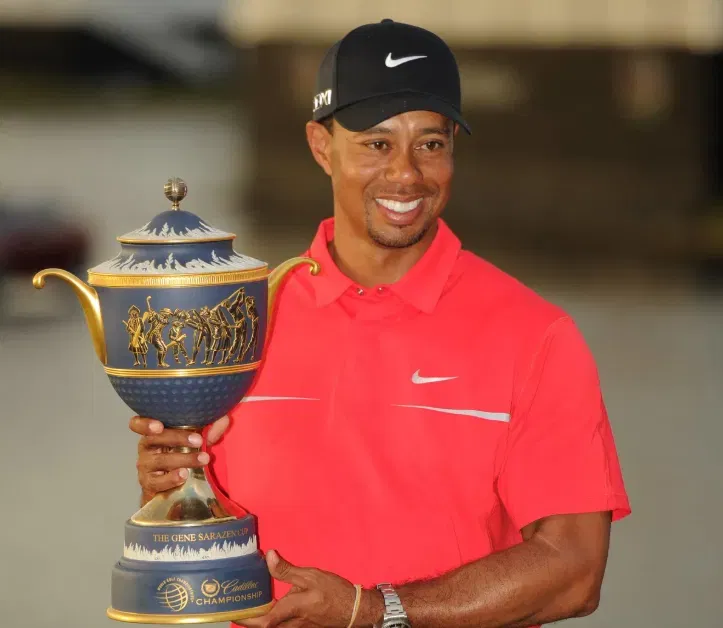
**FILE PHOTO** Tiger Woods and Nike End 27 Year Partnership. MIAMI, FL - MARCH 10: Tiger Woods celebrates during Final Round of the WGC-Cadillac Championship at the Trump Doral Golf Resort & Spa on March 10, 2013 in Miami, Florida. Copyright: xmpi04/MediaPunchx
Meanwhile, a new generation was reshaping the sport: Jordan Spieth, Justin Thomas, Brooks Koepka, and Rory McIlroy, all in their early to mid-20s, bombing the ball past 320 yards.
Norman believed that the gap was too big to close. However, Tiger closed it anyway.
How Tiger Woods Proved the “Younger Players” Theory Wrong
Despite Norman’s insistence that it was “very, very difficult” for a 40-year-old to match players in their 20s, Tiger’s actual results tell a different story.
1. 2018 Tour Championship: Tiger’s full-season return in 2018 delivered the first crack in Norman’s prediction. At the Tour Championship, he didn’t just contend; he controlled the tournament from the opening round.
Against this backdrop, a 30-player field featuring peak-form stars like Justin Rose, Rory McIlroy, and Bryson DeChambeau, Tiger proved he could still handle the very generation Norman believed would outpace him.
2. 2019 Masters: If the Tour Championship hinted at a comeback, the 2019 Masters confirmed it. On one of golf’s most demanding courses, Tiger outplayed the sport’s strongest wave of young contenders like Koepka, Schauffele, Johnson, and Finau, all in their athletic primes.
Furthermore, for a player Norman believed physically couldn’t “do it anymore,” Tiger delivered a major victory built on precision, experience, and mental toughness.
3. 2018 PGA Championship: Just months earlier, Tiger had already shown he could keep pace with the modern power era. His runner-up finish at the 2018 PGA Championship, highlighted by a final-round 66, pushed Brooks Koepka. Then the most dominant major performer, to the final holes.
Once again, Tiger didn’t stop rewriting the narrative after Augusta. In October 2019, he won the Zozo Championship, tying Sam Snead’s record of 82 PGA Tour wins. Even later, after his 2021 car accident, Tiger returned yet again, making the cut at the 2022 Masters despite severe physical limitations.
Competing and surviving four rounds at Augusta was itself a reminder that Norman’s belief about Tiger no longer being able to “match the young players” underestimated the one thing Tiger always had: competitive resilience.
Consequently, Tiger didn’t just come back once. He kept coming back. And when Norman was asked what advice he’d offer Tiger, he suggested a pragmatic route: reassess life, be realistic, plan ahead, maybe focus on business.
Written by

Dolly Bhamrick
Edited by

Sagnik Bagchi