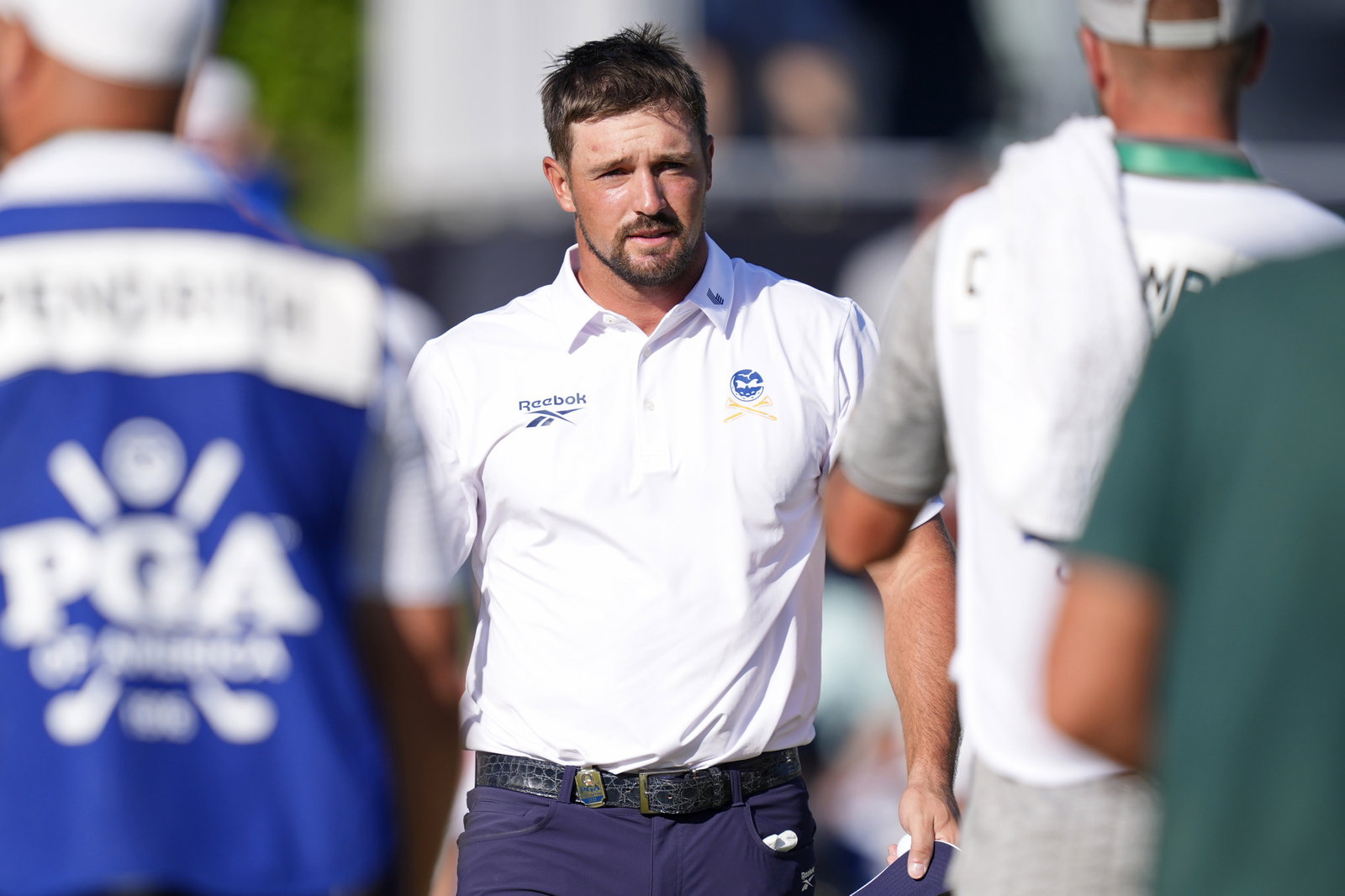
May 17, 2025; Charlotte, North Carolina, USA; Bryson DeChambeau reacts after finishing the 18th hole during the third round of the PGA Championship golf tournament at Quail Hollow. Mandatory Credit: Jim Dedmon-Imagn Images
Bryson DeChambeau missed the playoff by just one shot, but he finished the tournament with his best round of the week.
The two-time U.S. Open champion finished third at LIV Golf Korea on May 31. He shot a final-round 65 to end the tournament at 11-under par, one shot behind Joaquin Niemann and Talor Gooch, who reached the playoff at Asiad Country Club in Busan, South Korea.
After struggling in the middle rounds, DeChambeau turned things around on Sunday. He said the change came after a late-night conversation with Gemini AI rather than extra practice on the driving range.
"I feel like I'm on the right path now," DeChambeau told Flushing It after the round. "I felt really good this round; I felt better than I did in the first round, which is a good trend."
DeChambeau played well in the first round, but then his swing started to go wrong. His hands were moving too far ahead of the club, and he struggled for the next two rounds. He spent hours practicing on the range on Saturday night, but nothing seemed to help.
But on Sunday, he let his hands loose and posted 65.
DeChambeau also put the week into a broader context. Missing two major cuts after winning events earlier in the season stung, and he said so plainly.
"This game is so brutal," he said. "It can kick you when you're at your highest or bring you up when you're at your lowest. We have to respect the game for that."
His Crushers team moved into the outright lead in team victories at LIV Golf Korea. DeChambeau will play at LIV Golf Andalucia in Valderrama next week. After that, he will focus on trying to win his third U.S. Open title at Shinnecock Hills.
Bryson DeChambeau on the Late-Night AI Session That Changed His Sunday
Later, he returned to his room and used Gemini AI to help find the problem. He looked at different ideas, including physics, grip pressure, muscle tension, and how the club moves during the swing. He was trying to understand what was stopping the club from turning properly.
"I left kind of frustrated and learned later that night that I just needed to relax my grip pressure and let the thing just fold over naturally," he said.
A Flushing It reporter saw DeChambeau on the practice range at about 7:30 p.m. on Saturday. Even though it was already dark, he was still trying to fix the problem and had not yet found an answer.
"I was slamming the club in the ground trying to figure out what to do," DeChambeau said, "I didn't actually figure it out on the range. I went back and started talking to Gemini."
He spent time trying to figure out what was stopping the club from turning naturally during his swing. He specifically addressed the forward hand movement that had prevented the clubface from closing properly throughout the week.
After talking with Gemini AI, he was led to one possible cause: the pressure of his grip on the club.
"I'm still working it out," DeChambeau said. "I don't have the answer."
Third at LIV Golf Korea, a 65 in the final round, and a week that ended better than it looked on Saturday night.
Do you think DeChambeau can carry this form into the U.S. Open at Shinnecock Hills? Let us know in the comments.
Trending slideshow: Golf’s Biggest Paydays: Top Players and Their Mega Endorsement Deals
Aditi Singh
Golf’s Biggest Paydays: Top Players and Their Mega Endorsement DealsBehind golf’s calm greens lies a world of billion-dollar branding; from Tiger Woods’ era-defining Nike deal to Nelly Korda’s modern multimillion-dollar tie-ups, these players transformed success into legacy. Many of the partnerships on this list aren’t just about the money; they’ve built identities that shaped golfers’ and the brands’ image across decades. IMAGO / ColorsportWhen Tiger Woods turned pro in 1996, Nike saw more than a golfer — it saw a revolution. His “Hello, world” debut marked the start of a global partnership spanning nearly three decades and multiple renewals before ending in 2024. Earning over $500 million, Tiger’s dominance turned the swoosh into a golfing icon and himself into one of the most profitable athletes in sports history. USGA/John MummertRory McIlroy’s 2013 Nike deal symbolised golf’s next generation of global stars. The then-world #1 reportedly struck the $200 million deal owing to his dominance. With TaylorMade equipment and Omega watches complementing his image, Rory built a clean, polished brand, equal parts power and precision, proving golf could be young, international, and irresistibly marketable. Golffile Param Singh/EDI/ImagoPhil Mickelson’s relationship with Callaway lasted nearly two decades, defining his trusted image on and off the course. Known for his aggressive play and fan appeal, the partnership (undisclosed value) positioned Callaway at the heart of golf’s elite market. After joining LIV Golf, the association ended in 2024, closing one of golf’s longest and most recognisable endorsement eras. AFLOSPORT/ImagoJordan Spieth’s partnership with Under Armour began when he was barely out of college. Signed in 2013 and extended through 2029, it became one of golf’s most successful apparel collaborations. The brand grew alongside Spieth’s rise to world number one, producing signature collections and supporting his foundation. UA even supported Jordan Spieth's Family Foundation directly, committing to donate $1 million when signing the 2022 extension. Jeff Siner/Charlotte Observer/TNS/ImagoDustin Johnson’s effortless power made him the face of Adidas and TaylorMade for nearly 15 years. His clean image and consistent performances brought both brands global exposure. After his move to LIV Golf, the long-standing Adidas relationship ended in 2023, marking a quiet close to a partnership that once defined golf’s modern athletic look. Brian Rothmuller/Icon Sportswire/ImagoBrooks Koepka’s no-nonsense persona aligned perfectly with Nike’s competitive ethos. His apparel deal complemented his fierce on-course demeanour as he dominated major championships; with his later LIV Golf signing reportedly worth around $100 million, Koepka’s career embodies golf’s shift toward bold independence and financial reinvention. Matthew Bolt/Icon Sportswire/ImagoJon Rahm joined Callaway in 2021 after reaching world number one in 2020, merging power with precision in a high-profile partnership. Backed by Rolex and Mercedes, his image blended athletic strength and European class. In 2023, Rahm’s move to LIV Golf made headlines, with reports of a massive signing bonus marking his status as one of the sport’s most valuable stars. Ben Hsu/Icon Sportswire/ImagoGreg Norman turned success into an enterprise with his 1990s Reebok-backed Shark Apparel line, redefining athlete branding, becoming a global lifestyle brand. Beyond the course, Norman built an empire in design, wine, and apparel worth hundreds of millions. His transformation from champion golfer to CEO made him one of the original architects of sports business empires. Sammy Minkoff/ImagoArnold Palmer wasn’t just a golfer; he was golf’s first superstar brand. His deals with Wilson, Pennzoil, and Hertz in the 1960s and ’70s turned him into a household name. Palmer pioneered sports marketing, showing that personality could be as valuable as performance. His career-partnerships generated hundreds of millions and set the standard for every endorsement that followed. AP Photo/Kathy WillensJack Nicklaus built his reputation on discipline and grace, traits that attracted brands like Rolex. His long association with the luxury watchmaker symbolised timeless excellence. Combined with decades of course design and business ventures, Nicklaus’s brand remains synonymous with success and credibility; a quiet yet enduring legacy of sportsmanship. IMAGO / ColorsportSeve Ballesteros brought flair and passion to European golf, traits brands like Slazenger and Renault eagerly embraced. His sponsorships in the 1980s highlighted charisma over conformity, turning him into a continental hero. Though financial details remain historical, Seve’s influence on European golf’s commercial rise was undeniable. Colorsport/ImagoAnnika Sörenstam’s partnerships reflected her unmatched professionalism. Cutter & Buck, Rolex, and Callaway each captured a side of her: elegance, precision, and power. As one of the greatest female golfers, her brand expanded beyond competition, representing consistency and class. Her endorsements became benchmarks for women athletes seeking equity in sports marketing. Debby Wong/ZUMA Press Wire/ImagoMichelle Wie West signed with Nike as a teenager, making her one of golf’s earliest female prodigy endorsements. Reportedly worth around $20 million early in her career, the deal showcased Nike’s faith in youth and diversity. Despite the ups and downs of her journey, she remained a symbol of innovation and representation in women’s golf. Geoff Burke/ImagoLexi Thompson’s bold style found its match in Cobra Puma Golf. As one of the youngest LPGA pros, her vibrant presence brought colour to the game both literally and figuratively. The partnership helped redefine women’s golf fashion, promoting individuality and strength while keeping her among the sport’s most recognisable faces. Today, her total estimated endorsement earnings sit at around $4 million. Jorge Lemus/NurPhoto/ImagoRickie Fowler’s orange Sunday outfits made Puma a fixture on golf broadcasts worldwide. His long-term partnership, widely estimated at around $100 million, transformed him into a youth icon. Fowler’s confident flair and accessible charm turned Puma into a lifestyle brand for golf’s younger fans, proving that fashion and fun could thrive alongside competition. Gray Siegel/ZUMA Press Wire/ImagoHideki Matsuyama became Japan’s sporting pride after his 2021 Masters triumph. Backed by Lexus and Srixon, his endorsements reflect Japan’s deep reverence for excellence and discipline. With deals valued among the country’s largest, Matsuyama represents golf’s expanding global influence and the power of national icons in shaping brand prestige. AP Photo/ Matt YorkAdam Scott’s effortless elegance perfectly suits Uniqlo’s minimalism. Their partnership blends simplicity with global sophistication, showcasing Scott as the modern face of calm precision. His 2013 Masters win boosted the brand’s global image, reinforcing the link between quiet confidence and enduring style in professional golf. Vincent Ethier/Icon Sportswire/ImagoLydia Ko’s partnerships with PXG and Lululemon reflect balance, performance meets mindfulness. Her journey from teenage prodigy to mature champion mirrors both brands’ evolution. With a calm presence and thoughtful image, Ko represents the future of women’s golf: focused, grounded, and distinctly modern. Samuel Stringer/Icon Sportswire/ImaagoBryson DeChambeau’s scientific approach to golf made him both polarising and powerful. Cobra’s innovation-driven brand aligned with his data-driven mindset. Later, his LIV Golf signing reportedly pushed his total earnings beyond $100 million. His career proves that reinvention and risk can pay off handsomely in modern golf. Matt Stone-USA TODAY SportsViktor Hovland’s easygoing nature hides fierce consistency. His partnerships with Ping and J.Lindeberg balance performance with fashion-forward appeal. As Norway’s biggest golf export, Hovland’s brand bridges tradition and youth, representing golf’s next wave of understated global stars. Brian Spurlock/Icon Sportswire/ImagoCollin Morikawa’s precision caught TaylorMade’s eye early, leading to a long-term equipment deal. His Omega partnership added polish to his clean-cut image. After early major victories, Morikawa became the model of composed excellence, embodying a new era where technical mastery meets refined marketing appeal. AP Photo/Phelan M. EbenhackNelly Korda’s 2023 deals with Nike and TaylorMade cemented her as golf’s leading female face. Blending power, elegance, and global influence, she became the bridge between athleticism and beauty in modern sport. Each appearance reinforced her status as both champion and trendsetter, representing the LPGA’s new commercial strength. Golffile Steve Flynn/EDI/ImagoPaige Spiranac redefined golf influence through social media. Partnering with PointsBet and other brands, she turned digital charisma into commercial power. Her model of engagement-driven endorsements showed that visibility and relatability could rival traditional sponsorships, reshaping how athletes monetise their fame. Debby Wong/ZUMA Press Wire/ImagoFred Couples’ smooth swing made him golf’s most effortless ambassador. His longtime associations with Ashworth and Bridgestone reflected classic confidence. Even decades into his career, Couples remains a sought-after name, blending nostalgia with timeless appeal in every campaign he fronts. Jim Dedmon-USA TODAY SportsGary Player’s partnership with Rolex embodies enduring excellence. As one of golf’s original global champions, he represented discipline and resilience, values Rolex has long celebrated. His decades-long ambassadorship continues to symbolise tradition and class, proving that true legends never go out of style. Mark Newcombe/Imago