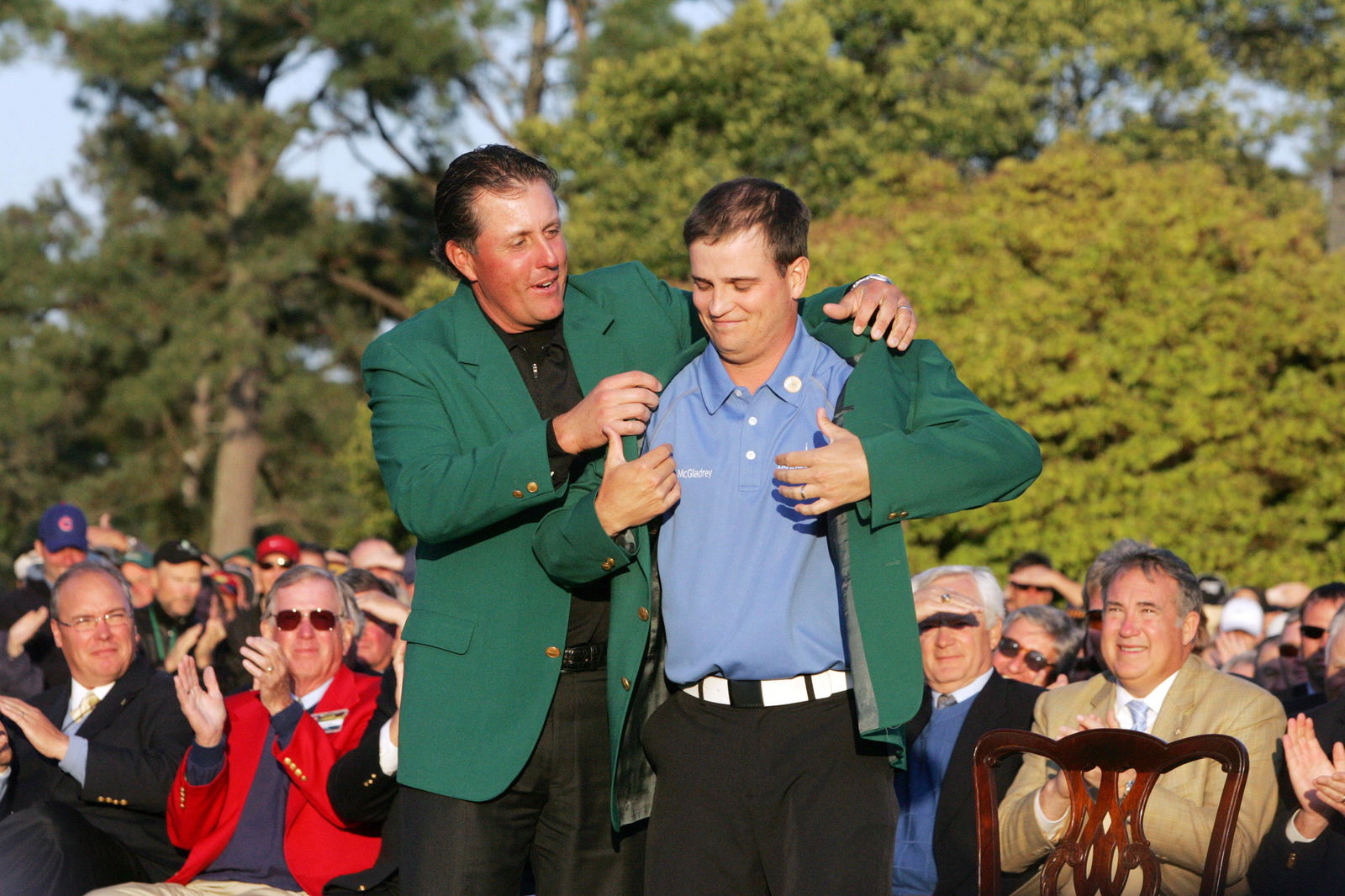
The 2006 Masters champion, Phil Mickelson left puts the green jacket on 2007 Masters champion Zach Johnson during the green jacket ceremony at Augusta National Golf Club in Augusta, Georgia, Sunday, April 8, 2007. Johnson won The Masters with a 1-over 289. Gerry Melendez/The State/MCT AUGUSTA GA USA EDITORIAL USE ONLY Copyright: xx 1042680 GerryxMelendezx krtphotoslive250671
The green jacket ceremony looks inevitable in hindsight, but it wasn't.
For years, Augusta National struggled to fill its own grounds before the tournament found its footing. One conversation later helped define what the modern Grand Slam looked like, and The Masters was part of it.
In 1960, Arnold Palmer and journalist Bob Drum were flying to Ireland for the Canada Cup, and they got to talking about what a modern Grand Slam might look like.
This version focused on professional golf rather than Bobby Jones’ 1930 Grand Slam, which included two amateur events. Palmer had already won The Masters and the U.S. Open that year, and he included both alongside the PGA Championship and The Open.
At the time, The Masters also had the biggest prize money. The winner got $17,000, which was more than the $14,400 paid at the U.S. Open.
That, along with Palmer’s run, started to change how people saw the tournament. Drum wrote about it, and the idea caught on. The British press picked it up at St Andrews, and from there, The Masters just kept getting mentioned with the biggest events in the game.
"One thing led to another," Palmer said. "Everybody picked up on it at St Andrews that year."
Around that time, Palmer and Drum helped frame The Masters as part of the modern Grand Slam.
But by the time that recognition started to take shape, Augusta National had already gone through years of uncertainty.
Before the Prestige, Augusta Was Struggling to Survive
The club was opened in December 1932 with 76 members instead of the 1,800 its founders had planned.
Bobby Jones and Clifford Roberts had originally wanted to host the U.S. Open, but it didn't go as planned. The United States Golf Association (USGA) declined because Georgia's summer heat made June staging impossible. So they built their own tournament instead.
It struggled financially, and the club defaulted on payments to course architect Alister MacKenzie, who died without collecting his fee. There was no substantial prize fund to start with. Members passed a hat around, and even that wasn’t enough.
The city of Augusta ended up putting in $10,000 for the 1934 event. They expected big crowds, around 20,000 a day, but it didn’t come close. It was closer to 1,000.
Things didn’t really pick up until 1939, when a local businessman, Alvin M. McAuliffe, got involved. That same year, the tournament was renamed The Masters, and ticket sales finally started moving through local businesses.
By the time people started talking about it as part of the Grand Slam, Augusta had already done the hard part. It wasn’t officially made a major. It just became one, because the tournament kept building something people couldn’t ignore.
Trending slideshow: From Birdie Chances to Nightmare Fuel, Augusta Holes That Test Masters Contenders
Eknoor Juneja
From Birdie Chances to Nightmare Fuel, Augusta Holes That Test Masters ContendersAugusta National might be the most beautiful golf course in the world, but playing it is a real test for any golfer. Even top professionals have trouble avoiding high scores thanks to the swirling winds at Rae's Creek and the famously tricky greens. It's rare for a rookie to win here, since every shot needs to be both precise and a little lucky. To do well at the Masters, players have to get through the tough back nine and make the most of the par 5’s. The course can quickly go from offering birdie chances to giving players a tough time. Wu Xiaoling/Xinhua/Imago"Hitting out of the narrow chute, my strategy is dictated by the wind," 5-time champion Tiger Woods explained. On average, players score 4.23 on this 465-yard hole that goes uphill and bends to the right. It is named for the ‘Ilex Opaca’ evergreen. You need to avoid the bunkers on the left side of the fairway to reach a deep green with 2 levels, which is protected by 2 more sand traps at the end. via Icon Sportswire/Imago"The trees both right and left are closer to coming into play than they look," 2011 winner Charl Schwartzel warned about this 450-yard uphill hole. Named for the lucky ‘Nandina Domestica’ shrub, it averages 4.16. You have to hit over the front sand traps to reach a green that tilts in every direction, which once featured the famous Eisenhower Tree. via Augusta National Inc."I didn't know whether I was holdin' the putter or it was holdin' me," 1967 winner Gay Brewer recalled of the tension at this 170-yard hole. Named for the orchid-pink ‘Cercis Canadensis’, it averages 3.14. You have to hit over the pond, which was added in 1947, to reach a green that slopes from right to left and is protected by 3 bunkers. Brian Morgan/Action Plus/Imago"I just had a feeling it was going straight for the green," Gene Sarazen recalled before his legendary 1935 double eagle. This 550-yard par 5, named after the thorny ‘Pyracantha Coccinea’, usually takes about 4.77 shots to finish. You need to hit over the pond and stay away from the bunker on the right to have a chance to reach the green in 2 shots. via Action Plus/Imago"The 14th is open, but so strongly contoured it's like there is a stone wall in front," Bobby Jones noted. This 440-yard hole is the only one at Augusta without any sand traps. Named for the rare Chinese Fir tree, ‘Cunninghamia Lanceolata’, it has a green with steps that slope sharply from left to right. Fran Caffrey/Golffile/Imago"It's a hole that lures you into wanting to do a little too much," 2015 champion Jordan Spieth warned about this 545-yard hole that curves to the left. Named for the course’s famous ‘Rhododendron’ flowers, it usually takes about 4.77 shots to finish. You have to cross the Byron Nelson Bridge and get over a small branch of Rae's Creek to reach the big green, which is protected by sand traps, in 2 shots. IncredibleGardens.org/Facebook"The 12th hole eventually makes you look like a fool," 2-time winner Ben Crenshaw said about this tough 155-yard hole. Named for the bright yellow ‘Forsythia Intermedia’ bushes, it has an average score of 3.27. You have to cross the Ben Hogan Bridge after dealing with tricky winds and Rae's Creek to reach the small green. Mike Hewitt/Action Plus/ImagoOn average, players score 4.30 on this 520-yard hole, which is the first part of Amen Corner. Swirling winds and a downhill shot that curves from left to right make it tough for every pro. The hole is named after the local 'Cornus Florida' tree and has a pond, added in 1950, that sits on the left side. You have to get past this impressive tree to avoid ending up in the water. Christer Höglund/TT/ImagoVery steep downhill slopes make this 495-yard par 4 the hardest hole on the course, with an average score of 4.30. Named after the imported ‘Camellia Japonica’ shrubs, it has a 60-yard-long bunker in the middle. You need to hit your first shot to the left-center to deal with a green that was moved in 1937 and now slopes sharply from right to left. via MastersNamed after the local ‘Prunus Caroliniana’ evergreen, this 460-yard par 4 usually takes about 4.14 strokes. You need to hit your drive down the right side to avoid 2 bunkers on the left near the green. Hitting from a slope up to a green with 3 levels makes it very important to control your distance, since shots used to roll back down the sloped front part of the fairway. Garry Ridsdale/robertharding/ImagoNamed for the twisting ‘Gelsemium Sempervirens’ vine, this 570-yard uphill par 5 usually takes about 4.82 strokes to play. You need to stay away from the sand trap on the right side of the fairway to reach the narrow green, which has no bunkers. Bobby Jones first designed this hole. The unique mounds next to the green were removed in 1956 but restored in 1979 to make bold shots more difficult. Mark Newcombe/Visions In Golf/ImagoNamed for the Argentinian grass ‘Cortaderia Selloana’ with its feathery flowers, this 450-yard hole usually takes about 4 shots to finish. You need to aim for the left-center of the fairway to stay away from a group of 5 bunkers. After 1936, the winner Horton Smith asked for more challenge, the hole was changed, and now you need an accurate short-iron shot to handle the steep, tricky slopes on the green. via Action Plus/ImagoNamed for the aromatic ‘Juniperus Virginiana’ evergreen, this 180-yard par 3 averages 3.14. You must account for a massive elevation change from the tee that creates a 1-club difference. While a stream and pond were removed in 1959, the shifting, undulating green levels make pin position a high-stakes puzzle. Petter Arvidson/Bildbyran/ImagoThis 495-yard uphill dogleg left takes inspiration from the Old Course’s Road Hole and is named after the large ‘Magnolia Grandiflora’ trees nearby. To clear the deep fairway bunkers, you need a 315-yard carry. Aim for the center of the green to handle its back-to-front slope and avoid the rear bunker, which can trap longer shots. via Masters TournamentOn average, players score +0.283 over par here, making this 240-yard downhill hole the toughest short hole on the course. It gets its name from the ‘Malus Hybrida’ trees, which bloom with deep-rose flowers. To play it well, you’ll need a long iron to handle the tricky winds and a careful approach to a green that used to be boomerang-shaped and is still protected by 2 large front bunkers. Fran Caffrey/Golffile/ImagoAlister MacKenzie saw this 350-yard hole as nearly perfect, so it has changed the least of any other hole. It gets its name from the bright ‘Prunus Persica’ blossoms. The hole averages a score of 4.08. To avoid losing a stroke, you need to judge the distance carefully because the green slopes from right to left and has a narrow section protected by a bunker. Curtis Compton/Atlanta Journal-Constitution TNS/Newscom World/ImagoFlanked by masses of native ‘Cornus Florida’ trees, this 585-yard dogleg left averages 4.78. You must wind the "throat" between 2 deep bunkers to reach the green in 2. Originally guarded by 1 right bunker, a left bunker was added in 1946 to test your approach on these colorful slopes. via Masters TournamentPlayers face a challenging uphill tee shot on this 445-yard dogleg right, which has a historical average score of 4.24. The hole is named after the fragrant ‘Osmanthus Fragrans’ shrubs. To play it well, you need to avoid the trees on the left and the front-left bunker, which was added in 1951. Accurate second shots are important to handle the 16 to 20-foot evergreen-lined greens and avoid a tough 2 -putt. WENN/Imago