
“That’s Why He’s the King”: Tiger Woods Once Revealed Why Arnold Palmer’s Impact Goes Beyond Trophies

Imago
March 17, 2002 - U.S. - KRT SPORTS STORY SLUGGED: BAYHILL KRT PHOTO BY BOBBY COKER/ORLANDO SENTINEL (March 17) ORLANDO, FL -- Arnold Palmer, right, meets with Tiger Woods after Woods captured the Bay Hill Invitational Sunday, March 17, 2002. (OR) NC KD BL 2002 (Horiz) (gsb) News Archive - March 17, 2002 - ZUMAm67
Arnold Palmer turned professional at a critical juncture in American golf's history in 1954. Palmer’s career evolved during the expansion of commercial television in U.S. homes in the 1950s and 1960s.
Television coverage of his tournaments increased visibility for the sport and spectator activity for national and international audiences. However, Tiger Woods revealed how Palmer didn't just get lucky, but utilized broadcasting to grow the sport.
In 2004, during Arnold Palmer’s final Masters appearance, Tiger Woods reflected on his influence and said, "If it wasn't for Arnold, golf wouldn't be as popular as it is now."
Palmer often selected shots involving risk, attempting putts and taking shots even when a lay-up option existed. Television coverage recorded these decisions and helped shape interest in golf as a spectator sport.
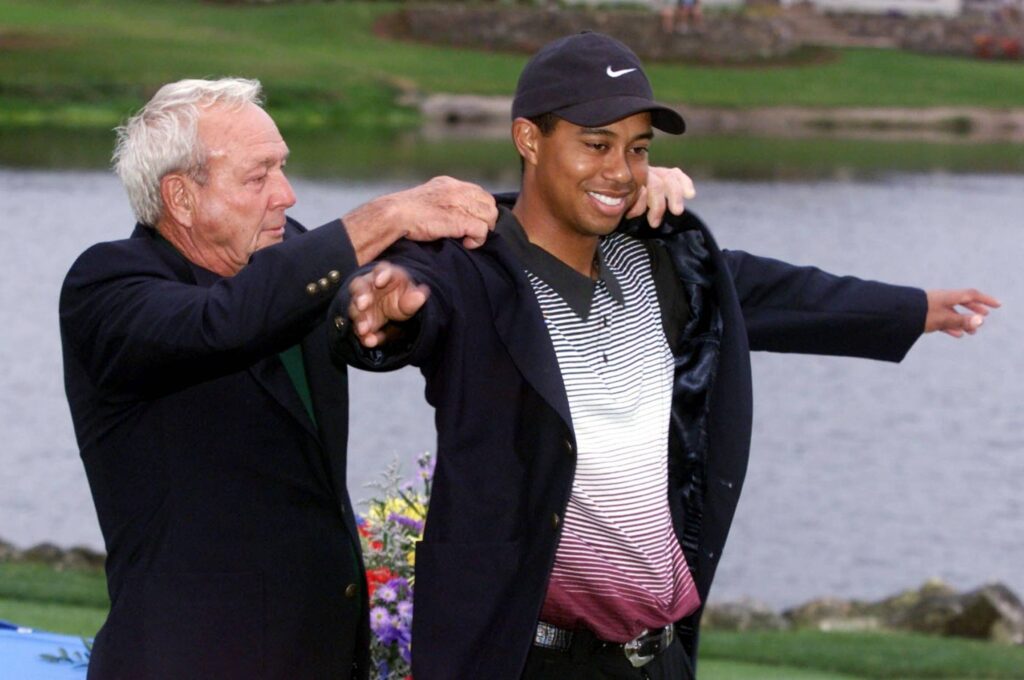
Imago
U.S. - KRT SPORTS STORY SLUGGED: BAYHILL KRT PHOTOGRAPH BY GARY BOGDON/ORLANDO SENTINEL (KRT1 - March 19) Tiger Woods, winner of the Bay Hill Invitational 2000, is receives his symbolic blue jacket from PGA Golf Herren legend Arnold Palmer. - ZUMAm67
"He's the one who basically brought it to the forefront on TV. If it wasn't for him and his excitement, his flair, the way he played, golf probably would not have had that type of excitement. And that's why he's the king," CBS News quoted Woods saying.
These coverages and Palmer’s "go-for-broke" approach contributed to the shift of golf from a country club sport to a mass-participation sport.
Arnold Palmer invigorated US golf on the global stage
Another crucial element of Palmer's influence was getting US fans excited again with his performances. Participation from American golfers in The Open declined after World War II, and Palmer’s first two appearances marked the period in which that pattern began to shift.
His entry into the 1960 event at St Andrews occurred while he was pursuing a Grand Slam after winning the first two major championships of that season.
Palmer finished one stroke behind the winner in his first appearance at The Open. He placed second to Kel Nagle in the Centenary Open, missing the Championship title by a single shot.
Palmer recorded his first victory at The Open in 1961 at Royal Birkdale. With that result, he became the third American player in almost three decades to win the Claret Jug, after Sam Snead and Ben Hogan.
Soon, the American fans had someone to cheer for. The following would later grow massive enough to earn the 'Arnie's Army' moniker.
Written by

Aditi Singh
Edited by

Sagnik Bagchi