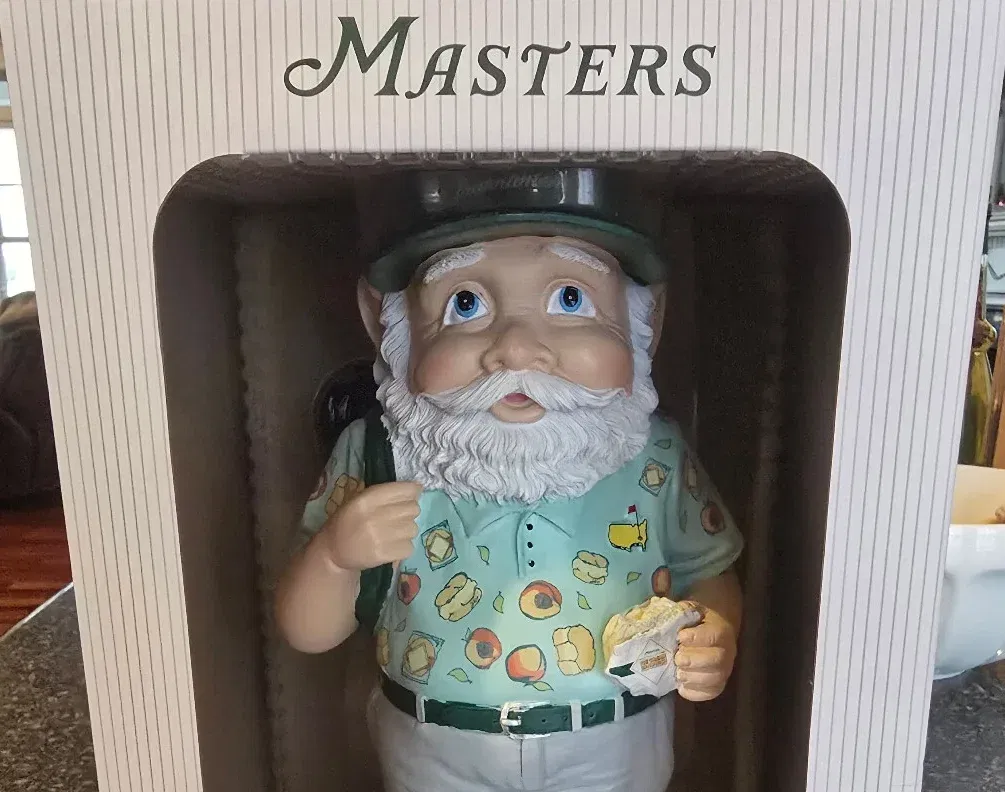
The Masters Tournament is famous for its pimento cheese sandwich and green jackets, but perhaps the most sought-after collectible is an over-foot-tall statue. The Augusta National gnome is a collectible that disappears faster than a Sunday lead at Amen Corner.
These statues have a new design each year, and they are only available at Augusta National during Masters week. Merchandise lines for the gnome are the first stop for thousands of patrons.
The high-demand gnomes typically sell out within the first 15 minutes after the shop opens each day. This is true even for credentialed media members, who are not allowed access to the shop until after the daily allotment is exhausted.
"It's hard to get the gnome if you are going as media… they sell out within the first 15 minutes," said Tom Coyne while interviewing Gene Wojciechowski. He explained that because of the timing of media access, you really have to know somebody to get a gnome.
To secure a gnome, patrons must enter the gates at 7:00 AM and go directly to the Main Golf Shop. With a maximum of one per customer, the daily allotment usually sells out moments after opening.
The newest edition features a new twist: a patron gnome with a coffee cup and a working Masters umbrella. This edition joins the 2025 gnome holding a peach ice cream sandwich and the 2024 “player” gnome in a blue sweater.
If you are late to the morning rush, your only option is the secondary market, where prices are extremely high. They are originally about $49.50 at Augusta National, but 2026 presales on eBay are already around $750, nearly 15 times the original price.
The Secret Strategy of the 7 AM Sprint
The gnome's appeal is tied to Augusta National not selling merchandise online. Owning a gnome is proof that someone was present inside the gates that year.
This level of scarcity mirrors other sought-after sports collectibles, such as player-specific shoes or championship programs. The gnome is no longer just decor. It has become a marker of access.
Each year’s design is retired after the tournament, which adds pressure for buyers to act quickly. Once it sells out, it does not return at retail price.
With larger crowds and rising resale prices, the early-morning rush for the gnome is starting to feel unsustainable.
Trending slideshow: Some Masters Stories Sound Unbelievable Until You Learn They Actually Happened
Eknoor Juneja
Some Masters Stories Sound Unbelievable Until You Learn They Actually HappenedEach April, golf fans head to Georgia for a tradition that feels as comfortable as their own local course. But behind the smooth TV coverage, Augusta National’s private grounds hold a history that is stranger than fiction. There have been tense hostage situations and secret, dramatic changes to the course. These unusual stories matter because they show the real, human side of this famous event, and confirm that the wildest Masters legends are actually true. Tim Dominick-Action Plus/ImagoIn October 1983, President Ronald Reagan was playing the 16th hole at Augusta National when a local man named Charles Harris crashed his truck through the gates. He ran into the pro shop, took people hostage, and demanded to speak with the President in person. Sven Simon/ImagoSecret Service agents quickly moved Reagan to safety while the gunman held the hostages for 2 tense hours. The President tried to call Harris twice to help negotiate, but Harris hung up both times before finally surrendering without anyone getting hurt. Circa Images/glasshouseimages/ImagoBetween 1943 and 1945, the Masters Tournament was put on hold due to global tensions. With no staff to care for the course, the club used its fairways as a farm, raising more than 200 cattle and 1,400 turkeys to support the war effort and keep the club going. Brian Morgan/Action Plus/ImagoFor 3 years, raising cattle replaced golf, but the farm was a financial failure. The cattle even ate many of the club’s prized azaleas and camellias. It’s still the only time livestock have taken over this famous golf course. Icon Sportswire/ImagoBobby Jones hoped his new course would host a major tournament and asked the USGA to hold the 1934 U.S. Open at Augusta National. The USGA turned him down, saying Georgia’s summer was too hot for championship golf. Mark Newcombe/Visions In Golf/ImagoUndeterred, Jones and Clifford Roberts started their own "Invitation Tournament" in 1934. This bold move grew into The Masters, which is now the most prestigious and sought-after title in professional golf. Mark Newcombe-Visions in Golf/ImagoAt the 2018 tournament, a fan named Johnny Pruitt had a massive heart attack and collapsed near the 11th green. His heart stopped, but 3 doctors in the crowd quickly performed CPR and saved his life. via Golf.comAfter surgery, Pruitt made a full recovery and came back exactly one year later to stand on the same spot where he had "died" for several minutes the year before. His story adds a powerful, personal touch to the legend of Amen Corner. via Golf.comTiger Woods’ near-hole-in-one in 2019 happened on a hole that wasn’t in the original 1931 plans. The well-known par-3 started as a simple 145-yard shot over a creek and was once seen as the "weakest" hole on the course. Curtis Compton/Atlanta Journal-Constitution TNS/Newscom World/ImagoIn 1947, Robert Trent Jones Sr. redesigned the hole, damming the stream to create the large pond seen today. Without this big change, many of the Masters’ most famous Sunday moments would never have happened. @rtj2golfdesign/InstagramThe course layout was once very different, with the front and back nines switched. After the first tournament in 1934, they swapped the order since the lower holes, now the back nine, often had morning frost. Petter Arvidson/Bildbyran/ImagoSwitching the holes meant the swampy "Amen Corner" could thaw later in the day. This practical change led to the famous "back nine" finish and set the stage for some of golf’s most exciting Sunday moments. via Dreamstime/ImagoAugusta National keeps its secrets well, but these stories reveal a more complicated, human history. From hostage situations to cattle on the course, the real story is often much stranger than the polished legends we hear. Brian Morgan/ActionPlus/ImagoLooking back at history shows that even the most respected traditions have wild beginnings. These stories show that the most incredible Masters legends are rooted in real, often surprising events. via Aflo Sport/Imago