
What Makes Tiger Woods Tiger Woods: Skill, Mindset, and a Relentless Hunger to Dominate

Imago
152nd Open Championship Tiger Woods USA at the 18th during Round 2 of the 152nd Open Championship, Royal Troon Golf Club, Troon, South Ayrshire, Scotland. 18/07/2024. Picture: Thos Caffrey / Golffile.ie All photo usage must carry mandatory copyright credit Golffile Thos Caffrey Troon Royal Troon Golf Club South Ayrshire Scotland Copyright: xThosxCaffreyx *EDI*
Few athletes have shaped their sport the way Tiger Woods has shaped golf.
From prodigy to global icon, his career has been defined not just by wins but by an intensity and presence that fundamentally changed how the game is played and consumed.
Even decades into his professional journey, Woods remains a reference point. As he turns 50 today, let’s celebrate some of the traits that make him the legend that he is.
Tiger Woods Began Early With a Competitive Mindset
Woods’ father, Earl, introduced him to golf when he was just six months old, and made an appearance on The Mike Douglas Show when he turned two. During his teenage years, he separated himself from his peers, winning three back-to-back US Junior Amateur titles (1991 - 1993), and then went on to win three straight US Amateur Championships (1994 - 1996). That's an unmatched feat in the history of golf.
His first professional tournament came at 16, at the Los Angeles Open. Two years later, he made the 36-hole cut, finishing T34 at the Johnnie Walker Asian Classic, before entering Stanford University. In two years of his collegiate career, Woods won 10 events and secured the NCAA title. This was just the beginning of his lucrative career.
Dominance That Redefined an Era in Golf
Woods turned professional in 1996. He played eight PGA Tour events, won two of them, and became the Rookie of the Year. Just nine months after turning professional, he got the Masters Tournament win. He won his first major by 12 strokes, becoming the youngest Masters champion at the age of 21.
Between 1997 and 2008, Tiger Woods won 14 major championships. 2000-2001 marked the ‘Tiger Slam’, where he held all four major titles simultaneously. During that same stretch, he spent a record 683 total weeks as world No. 1, including 281 consecutive weeks from 2005 to 2010, the longest reign in golf history.

Icon Sportswire
LA JOLLA, CA - FEBRUARY 16: Tiger Woods looks on during the trophy ceremony following the final round of The Genesis Invitational 2025 at Torrey Pines Golf Course on February 16, 2025 in La Jolla, California. Photo by Brian Rothmuller/Icon Sportswire GOLF: FEB 16 PGA, Golf Herren The Genesis Invitational EDITORIAL USE ONLY Icon250216042
Through his career, Woods has won 15 majors and 82 PGA Tour events. He stayed the #1 golfer for a record of 683 weeks, enforcing dominance on the tour.
Woods has shown consistency under pressure
Control under pressure was the one aspect that put Woods under the spotlight. From 1997 to 2008, Woods converted 41 of 54 PGA Tour victories when holding or sharing the 54-hole lead, a closing rate unmatched in modern golf. His ability to protect lead became a defining trait of his dominance. That pattern was even more pronounced at major championships. Woods finished 14-for-14 when leading after 54 holes in majors.
He once said, “I played at a high level for a long period of time. I won my fair share of tournaments, I lost my share of tournaments, but I was proud of the work that I put in to keep myself there and keep trying to get better.”
Tiger Woods Has an Impact Beyond the Scorecards
Woods’ presence changed how the public engaged with golf. His early success drove record television ratings, including the 1997 Masters Sunday broadcast drawing a 14.1 Nielsen rating and the 2001 Masters 13.3, among the highest in event history. These numbers surpassed those for the likes of Jack Nicklaus, Arnold Palmer, and other legends.
His $40 million Nike endorsement, signed in 1996, helped launch the brand’s golf division, which grew nearly tenfold within two years of his arrival. This inspired Nike to state, “Tiger, you challenged your competition, stereotypes, conventions, the old school way of thinking. You challenged the entire institution of golf. You challenged us. And most of all, yourself. And for that challenge we’re grateful.”
Resilience Through Injury and Adversity
Even though he had a lucrative career, it wasn’t free from serious injuries and setbacks. Between 2008 and 2017, he underwent multiple surgeries on both knees and his back, including four back surgeries, culminating in a spinal fusion in April 2017. At the time, Woods openly questioned whether he would ever compete again, citing daily pain and limited mobility.
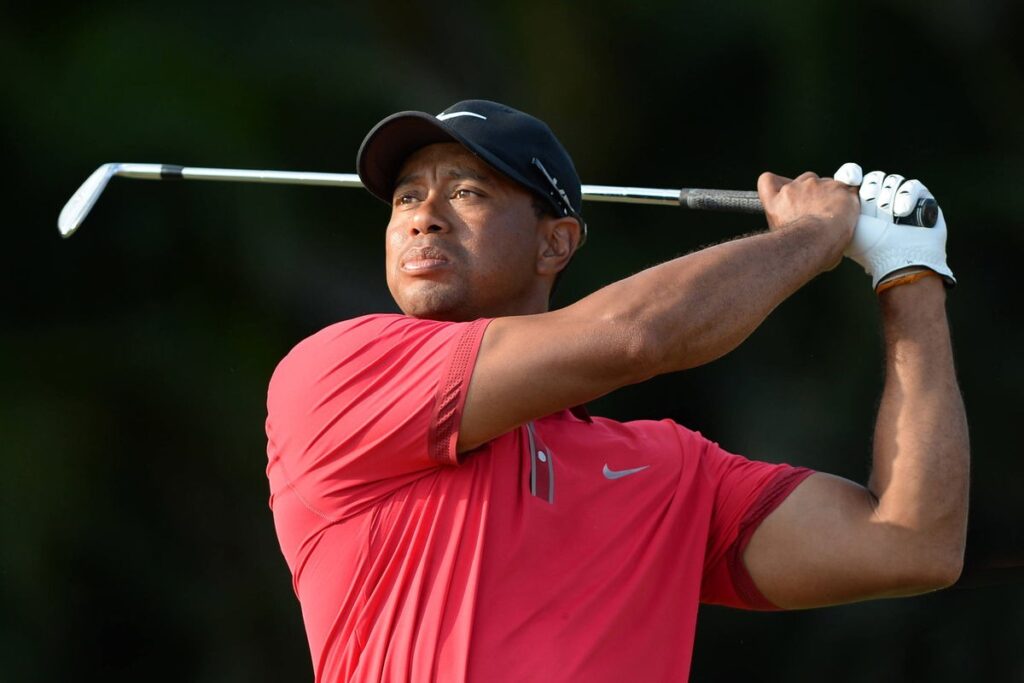
But he ensured a dramatic return. Less than two years after spinal fusion surgery, Woods won the 2019 Masters Tournament (fifth Green Jacket), his first major in 11 years, becoming the second-oldest Masters champion in history at age 43.
Woods told CBS Sports, “I hurt every day. I ache every day.” But his resilience outshines his pain.
Tiger Woods’ Signature Identity & Personal Rituals
Woods’ red shirt on Sundays became his identity for most of his career. When asked, he announced that his mother, Kutilda, often told him that red was his “power color.” And the tradition became his signature.
Beyond apparel, his rigid preparation rituals kept the emphasis on control and repetition. His practice sessions followed structured patterns, his pre-shot routine remained virtually unchanged for decades, and his emphasis on mental visualization set a benchmark for elite performance. No wonder he became an icon of golf.
Woods’ Enduring Legacy
Woods’ legacy is measured not only in trophies, but in how permanently he altered golf’s trajectory. His influence reshaped training standards, expanded the sport’s global audience, and set competitive benchmarks that continue to define excellence for current and future generations.
His impact on golf endures across generations, records, and culture. As the game continues to evolve in his shadow, let’s wish a very happy birthday to an icon who changed it forever.
Written by

Krushna Pattnaik
Edited by

Oajaswini Prabhu